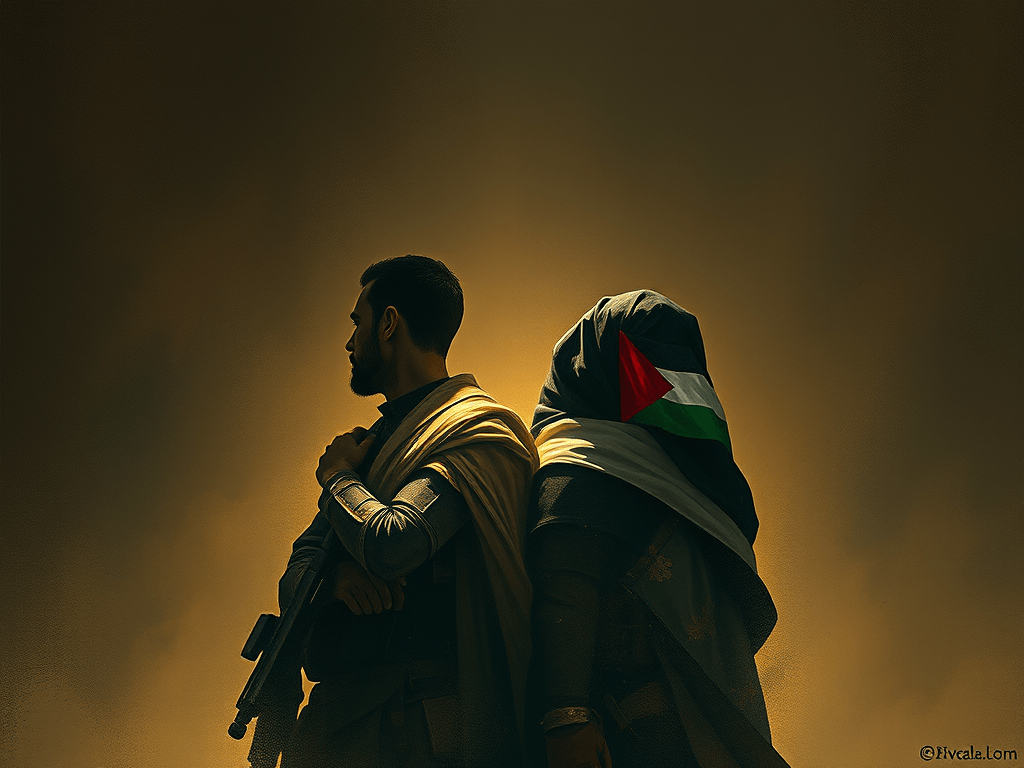
I. THE SURFACE — A DEADLOCK THAT RESISTS EVERY EXPLANATION
The conflict between Israel and Palestine has become the defining deadlock of the modern world — a crisis so persistent that it feels welded into the very horizon of history. Decades of negotiation, diplomacy, resistance, violence, rhetoric, appeals to justice, and calls for peace all orbit the same immovable center. Each generation returns to the same unresolved question, and each new attempt to solve it circles back to the same impasse. The conflict does not progress; it resets.
The usual explanations — political, religious, moral — illuminate the surface but never its depth. Politics explains the distribution of power and territory but not the intensity of identity. Religion explains symbols and claims but not their binding force. Morality explains grievances and injustices but not why each side feels both accountable and wronged, victim and inheritor, chosen and accused.
Everything that should explain the conflict ends up explaining only its symptoms.
The impasse persists because the conflict is not merely political, theological, or moral. It is structural. It operates inside the deep narrative architecture that shapes collective consciousness. This is why the situation feels at once ancient and current, mythical and brutally contemporary: it belongs to the level at which history writes itself.
This was Paul’s claim in his Letter to the Romans. When he reflected on Israel’s “role,” he did not interpret it theologically or politically, but dramaturgically. Israel was not chosen for superiority; Israel was chosen first — not to be above the nations but ahead of them, bearing in concentrated form the tension that all peoples would later inhabit. Paul saw Israel’s story not as a privilege but as a prototype. What unfolded there was what would unfold everywhere. The drama of identity and promise, obligation and rupture, belonging and exclusion, was not Israel’s problem; it was the world’s.
And now the world watches the conflict not because it is unique, but because it is our shared crisis made visible on its original stage.
II. THE DEPTH — PAUL’S VISION OF THE ROLE, AND THE STRUCTURE BENEATH IT
Paul’s insight begins with a reversal: Israel is not an exception to humanity; Israel is the place where humanity is first revealed. The role of “chosen” is not a medal but a burden — an assignment to encounter the drama of consciousness before anyone else. When Paul writes of Israel’s stumbling or hardening, he does not mean moral failure; he means structural tension. A narrative cannot move without resistance, and the first act of any drama concentrates its conflict in a single figure or setting.
For Paul, Israel is that figure and that setting. This becomes clearer when one sees the structural dimension of identity: the way law creates tension, the way promise creates expectation, the way history creates the illusion of direction even when none is visible. Paul understood that Israel’s conflict was not an isolated struggle but a concentrated version of what every people and every person eventually confronts: the burden of carrying a narrative larger than oneself.
The modern conflict is therefore not a failure of diplomacy, empathy, or rationality. It is the reenactment of the same structural tension Paul described. Two identities bear the same dramaturgical assignment. Two stories attempt to carry the same promise. Two peoples stand inside the same narrative role. The conflict is not symmetrical in power, but it is symmetrical in structure.
III. THE HORIZON — THE SHARED ROOT: JUDAISM, ISLAM, AND THE POSSIBILITY OF RECOGNITION
Both Judaism and Islam spring from the same root — Abraham — yet they shape that inheritance in profoundly different dramaturgical forms.
Judaism understands the story as covenant: a bond that draws the world toward restored wholeness. Covenant is not merely agreement but mutual orientation: God turns toward Israel, and Israel turns toward God, and history moves through the rhythm of estrangement and return. In this frame, the human role is to guard the promise that leads toward eventual unity.
Islam, by contrast, understands the same origin as submission — not submission to force, but to the logic of the story itself. To submit is to recognize the unity already present beneath division and to accept one’s place within it. Where Judaism emphasizes the path toward restored wholeness, Islam emphasizes the recognition of the wholeness already underlying reality. One moves toward unity, the other stands within unity.
They are not rivals. They are mirror-stances toward the same narrative structure. And because each expresses a different, necessary pole of the same dramatic role, neither can simply absorb the other’s horizon. Both must defend their claim, not out of pride or hostility, but because each carries half of the structural truth. It is here — at the root — that dialogue becomes possible.
For both traditions aim in the same direction: toward coherence, unity, and restored order. Each attempts to articulate how the world might become whole. The tragedy lies not in the differences, but in the shared impulse to secure the ending by human means: by law, by doctrine, by memory, by resistance, by political control.
But the ending of the story is not in human hands. And it never was. This is the point Paul strains to convey: the resolution is structural, not political; a shift in perspective, not a shift in borders. Judaism cannot complete the covenant by its own effort. Islam cannot manifest unity through human submission. And neither can force a conclusion that belongs to the drama itself. Once this is seen, a new horizon opens: the possibility that both traditions, far from canceling one another, are partners in revealing the structure whose fulfillment neither can achieve alone.
And this — quietly, unexpectedly — is the first genuine point of contact, the first place where the deadlock becomes porous, the first moment where recognition might begin. Not through peace talks, nor treaties, nor victories, but through the simple realization that the story they inhabit exceeds them – and therefore frees them from the burden of finishing it.
 laurentiuspaulus