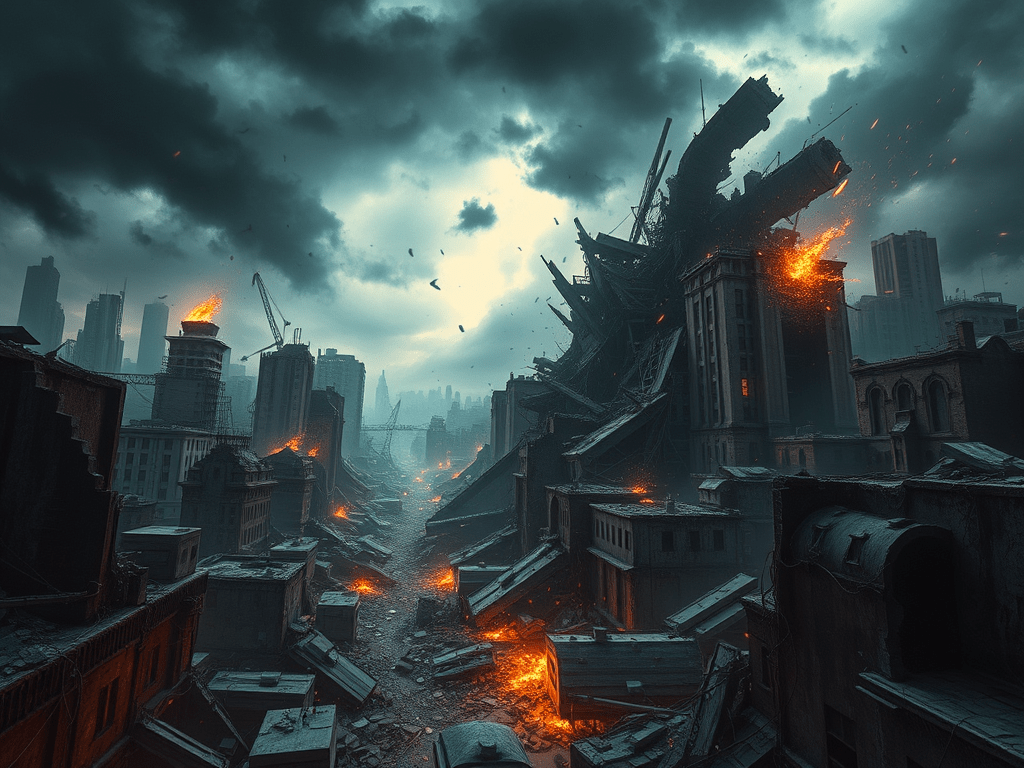
When the World Loses Control — Why Global Collapse Follows the Same Logic as a Human Life
Modern societies like to imagine themselves as rational systems guided by conscious decisions, long-term planning, and collective responsibility. For most of the last century, it was possible to believe that progress was something we produced, that crises could be prevented with better governance, and that stability was the natural reward for intelligence and discipline. Nations treated themselves as competent individuals writ large: capable of correcting mistakes, learning from history, and steering the future. That belief has shaped every major institution of the modern world — political, scientific, economic, and cultural.
The last two decades have brought this confidence into question. Democracies that once appeared robust now struggle to form governments. Economies grow more volatile even when they expand. Climate systems behave in ways that make prediction unreliable. Conflicts rise in places that were assumed to be permanently stable. Technology develops faster than the societies that attempt to regulate it. What was once called “the international order” no longer behaves like an order at all. None of this indicates that humanity has suddenly become less competent. It indicates that the world has crossed a threshold — the point at which human-designed systems no longer match the complexity of the forces acting on them.
In this sense, global collapse mirrors the logic of collapse in an individual life. When a person’s strategies and structures cease to work, outsiders often interpret the event as a failure of discipline or foresight. Something similar happens at the societal level: every malfunction is moralized. Climate instability is blamed on insufficient willpower; political fragmentation is blamed on ignorance; economic turbulence is blamed on poor leadership. The assumption is the same in both cases: if control is lost, someone must have mismanaged it. But collapse is not a moral event. It is a structural event — the moment when the magnitude of the forces acting on a system exceeds its capacity to respond.
This is precisely the difference the apostle Paul articulated two thousand years ago when he distinguished between “human righteousness” and what he called “the righteousness of God.” Stripped of religious vocabulary, the distinction describes two modes of movement: the first is powered by human effort, intention, and control; the second begins only after the first has reached its limit. Paul did not develop this idea abstractly. His own life repeatedly fell apart. His plans failed, his projects were interrupted, and he encountered more resistance than success. What impressed him was not the collapse itself, but the insight that collapse revealed a deeper logic — a movement not powered by his own strength.
Seen this way, the modern world stands in a similar position. The structures that carried the twentieth century — faith in democracy, economic growth, international cooperation, institutional authority, rational governance — functioned well as long as the systems they attempted to manage remained within a certain range of complexity. That range has now been exceeded. The global order is encountering the same boundary conditions that an individual encounters at the edge of exhaustion: effort no longer produces the results it once did, and control no longer stabilizes what it once held together. This does not mean humanity has failed. It means humanity has reached the point where its own power no longer determines the movement of events.
The collapse of control is frightening on both levels — personal and global — because it dismantles the illusion that stability is primarily a function of competence. But the loss of control is not the end of movement. It is the moment when the source of movement shifts. An individual discovers this when their personal capacity breaks and life continues anyway, carried by a momentum they did not create. Societies discover it when the structures they built can no longer contain the forces acting on them, and yet history continues to advance according to a logic no one designed.
This is why the current global moment, however dark it appears, is not merely a period of failure. It is a transition from one mode of historical movement to another — from the era in which humanity imagined itself to be the primary agent, to the era in which the deeper structure of the story becomes visible. The world is not collapsing into chaos. It is moving into the part of the narrative where the limits of control reveal the actual architecture of history.
In this light, the turmoil of our moment is not a sign that humanity has lost its way, but the unmistakable indication that we have entered the phase where the story itself begins to carry the world. The breakdowns are not the end; they are the point at which the real movement begins.
 laurentiuspaulus