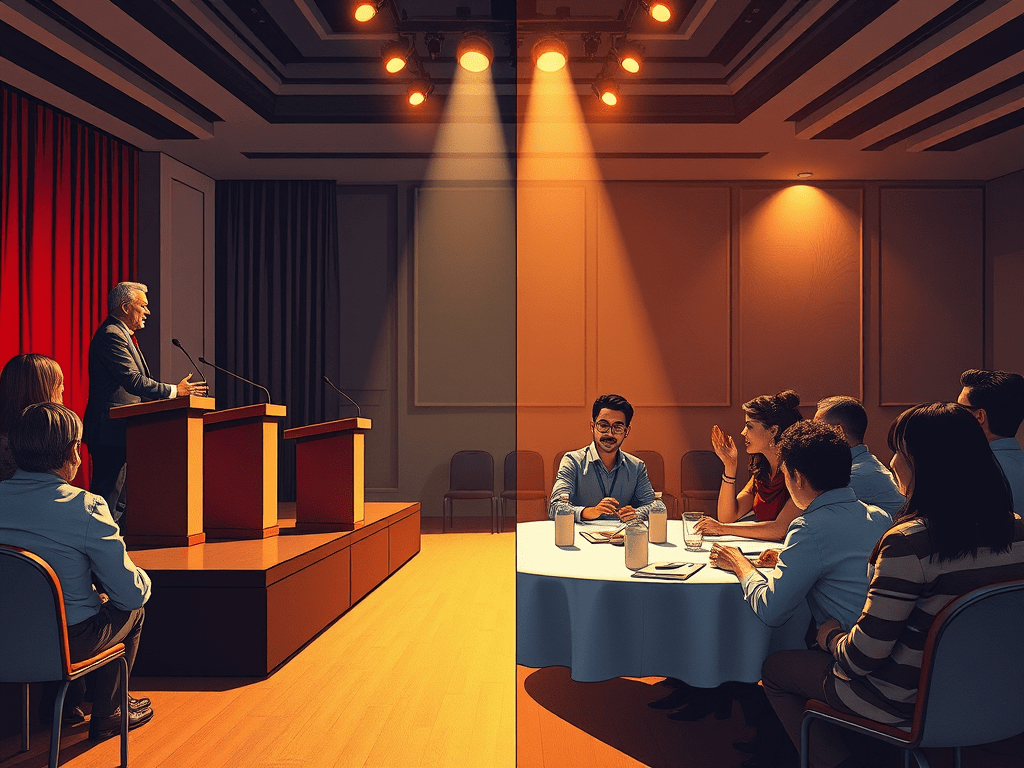
Prologue — A Reflex Exposed
While drafting the previous essay, Religious Revival: A Mirror to Secularization’s Transformation, I detected a subtle but unmistakable shift inside my own thinking: without noticing it, I had drifted back into the intellectual posture of critique. I had presented an argument about why contemporary religious revivals reveal the internal transformation of secularization, and within seconds I could also anticipate the most obvious counter-move — that revivals do not mirror secularization at all, but instead represent a rejection of it, an assertion of identity against modernity rather than an expression of its structural logic. The counter-argument is not only predictable; it is entirely legitimate. And the instant awareness of that legitimacy exposed the deeper issue: any text written in the grammar of critique is automatically vulnerable to critique in return. It invites the very mechanism it attempts to resist. The fatigue that followed was not emotional but structural: critique no longer feels like an instrument of thought, only like a reflexive inheritance from an earlier intellectual ecology.
The recognition became the starting point for this essay. It is not an admission of error, nor a personal confession; it is simply the observation that my own mind still carries patterns shaped in the age of debate, even as the surrounding culture has already begun to move beyond it. When the reflex became visible, my first instinct was to discard the entire essay. The fear was not profound but familiar: that the argument would appear naïve, that I had overlooked something obvious, that I would seem unintelligent for having written in a register already out of step with current intellectual conditions.
Yet the impulse to erase proved less interesting than the opposite one — the recognition that a text can be corrected rather than hidden, clarified rather than abandoned. Acknowledging one’s own conceptual missteps is not flattering, but it is at least truthful, and truthfulness is a more reliable guide to understanding than the preservation of self-respect. The moment therefore served as its own instruction: rather than delete the essay, I revised it, and in doing so saw more clearly the historical reflexes I had inadvertently reactivated.
I. Debate as the Cognitive Architecture of a Previous Era
For those educated in the late twentieth century, debate was not an optional skill but the fundamental shape of intellectual life. Knowledge circulated slowly; information was scarce and often contested; and the most credible path to clarity was confrontation. To be articulate meant to hold a position. To be intelligent meant to defend it. Academic culture, public discourse, and even informal conversation treated contradiction as the natural form of inquiry. Rationality was performative and adversarial, shaped by institutions in which victory, coherence, and rhetorical strength were treated as indicators of truth.
It is easy to forget how deeply this form shaped one’s identity. Opinions were not simply ideas one held; they were extensions of the self, markers of maturity, evidence of seriousness. The critical stance was not only an intellectual habit but a psychological posture, a learned readiness to counter, to refine, to resist being outmaneuvered. That environment formed a generation for whom debate was synonymous with thinking itself.
II. A Classroom Encounter: When the Form Itself No Longer Resonates
Years later, while working as a substitute religion teacher, I encountered the first clear sign that this cognitive architecture no longer held. I attempted to spark discussion on biblical interpretation, expecting students to engage as my own generation once had — to contest meanings, compare readings, and position themselves in relation to the text. Instead, the classroom remained silent. It was not the silence of fear or indifference; it was the silence of people for whom the entire discursive form felt irrelevant. They understood the content perfectly well. What they did not recognise was the invitation to debate it. The absence of engagement was not a failure on their part; it was a signal that my assumptions about what constitutes “discussion” belonged to another era.
In retrospect, this classroom moment was the first empirical indication that debate had ceased to function as a shared cognitive mode. It was not that young people lacked opinions or capacities for reflection; rather, they did not experience interpretive disagreement as a meaningful or necessary mode of participation. They were inhabiting a different intellectual ecology altogether.
III. Debate as a Cognitive-Physiological State
Recognising this generational divergence also cast new light on the inner mechanics of debate itself. What had once felt like disciplined thinking increasingly appeared as a form of physiological activation: the mind narrowing, rehearsing counterarguments, generating imaginary interlocutors, tensing itself in preparation for impact. Debate was not merely an exchange of reasons but a somatic pattern — a whole-body orientation toward uncertainty, primed not for understanding but for defence. The speed with which the body enters this state reveals how ancient and automatised it is. One need not even be in conversation; the mind can produce the entire adversarial theatre internally.
This neurological loop, once mistaken for intellectual engagement, now appears as a residue of a world in which knowledge was a scarce resource and identity a fragile construction. Debate, viewed from this angle, is less an epistemic tool than a historical reflex, a leftover strategy for surviving conditions that no longer exist.
IV. Social Media and the Systemic Exhaustion of the Debate Paradigm
If the classroom moment revealed the fading relevance of debate, social media revealed its structural impossibility. Online environments are designed in such a way that every statement becomes the seed of infinite counter-statements. No argument can ever settle; no conclusion can stabilise; no position can stand without immediately generating its own negation. The result is not pluralism but recursion — an endlessly branching landscape of claims, rebuttals, meta-rebuttals, and reframings.
In such a system, debate ceases to function as a path to truth and becomes instead a self-replicating engine. The inability of discourse to reach resolution is not a failure of reasoning but a property of the medium itself. This realisation did not provoke cynicism; it simply made argumentation seem structurally obsolete. A form of cognition that presupposes the possibility of closure cannot survive in an environment that renders closure impossible by design.
V. Debate Clubs as Institutional Survivals
This historical transition becomes especially visible when viewed against the persistence of formal debate cultures — particularly in the United States, where debate teams continue to be celebrated as markers of academic excellence. Observed from within twenty-first-century epistemic conditions, such institutions resemble survivals from an earlier intellectual regime. They train students to master a cognitive form that no longer serves its former purpose. In a world of immediate access to information, “factual” victory becomes irrelevant; in a world of algorithmic mediation, rhetorical dominance has little correlation with insight. The skills cultivated in debate clubs — rapid rebuttal, positional combat, adversarial stance — belong to a communicative ecology that is already fading.
This is not a judgment on those who participate, but a recognition that the socio-technical environment around them has changed. The competencies that once secured intellectual authority are becoming structurally mismatched to the world they aim to interpret.
VI. A New Generation Born After Debate
The most decisive evidence of this cognitive shift comes from the behaviour of young people. They do not avoid debate out of apathy, nor because they lack intellectual curiosity, but because the entire oppositional form strikes them as unnecessary. Their identity is not anchored in opinion. Their social interactions rely on fluidity, contextual sensibilities, shared atmospheres, and rapid shifts across domains. What appears to older generations as disengagement is, in practice, a different epistemic strategy — one oriented toward coherence rather than victory, toward understanding rather than stance.
The refusal to argue is not a symptom of weakness; it is an indicator that the adversarial model of knowledge no longer maps onto lived experience. They have grown up in an environment where information is ambient, not scarce, and where meaning arises from patterns, not positions. Debate feels antiquated because it is: it originates in an intellectual landscape they never inhabited.
VII. Recognition — From Opposition to Structure
Stepping back from these observations reveals a simple conclusion: the age of debate is ending, not through cultural decree, but through a gradual recognition of its structural insufficiency. The form itself persists, yet increasingly without conviction. A transition of this magnitude does not occur cleanly; it requires a collective experience of exhaustion, a recognition that adversarial modes of thought no longer align with the tempo or texture of contemporary life. This exhaustion is already visible at the level of individual behaviour. The steady withdrawal from social media, the reluctance to engage in protracted argument, the quiet acknowledgement that the mental state produced by debate is out of sync with present realities — these are all early signals of a deeper shift. People are not abandoning discourse; they are abandoning a form of discourse that no longer delivers meaning.
What emerges instead is a different orientation: one that seeks the generative structures beneath positions rather than the victory conditions between them. The dissolution of debate, understood in this light, is not a symptom of passivity but a reconfiguration of cognitive priorities. Oppositions that once appeared as the engines of intellectual life now reveal themselves as surface effects of broader, more integrated systems. The recognition of this fact does not eliminate disagreement, but it reframes the role disagreement plays. It moves inquiry from contestation toward coherence, from adversarial identity-building toward structural understanding. The fatigue that accompanies any return to critique is therefore less a personal reaction and more a sign of historical transition: evidence that the ecology of thought is reorganising itself in ways that the old habits of debate can no longer sustain
 laurentiuspaulus