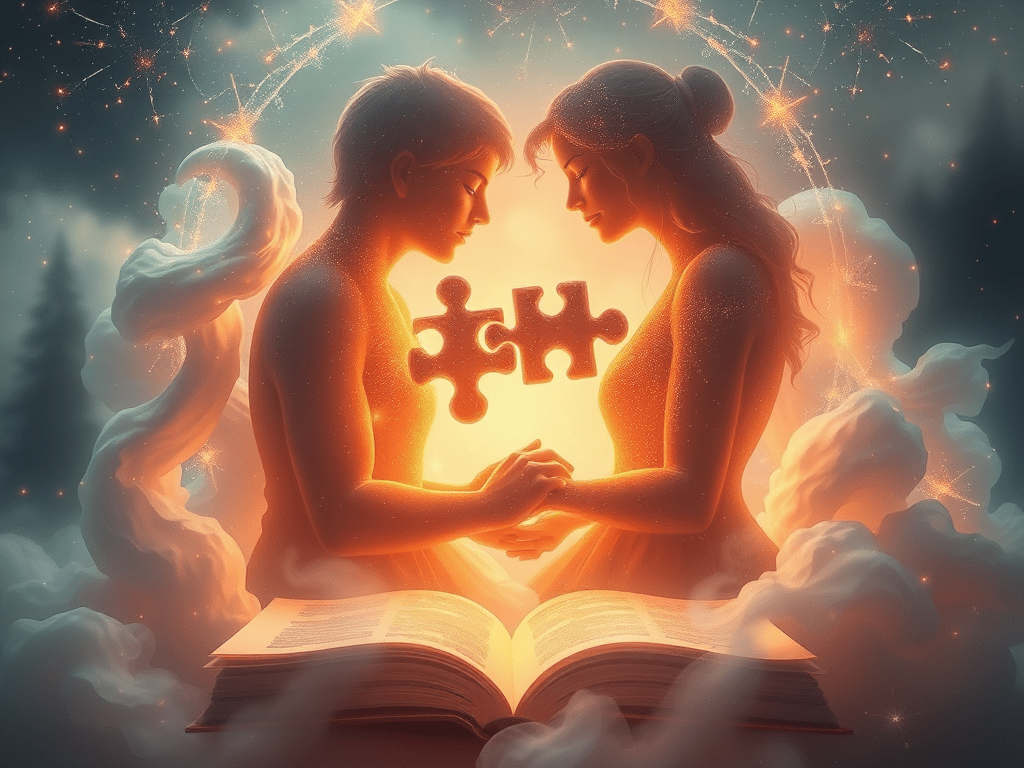
The One Who Fits the Story
Grammar of Falling in Love
I. Why “The One” Refuses to Disappear
There are ideas that survive even when an entire culture decides they should be obsolete. One of the most persistent is the notion of “the one” — the intuition that among billions of people there exists someone who fits us in a way no one else does. Modern societies often dismiss this as romantic naïveté or narrative conditioning, yet the experience itself does not vanish. People continue to report encounters that feel strangely inevitable, meetings that clarify something unarticulated in their own lives, moments that seem to complete a sentence they did not know they were writing. The idea persists because it corresponds to a truth not about metaphysics but about structure. Love endures as a phenomenon because human meaning is not random; it has a form. And the sensation of “the one” is what it feels like when another person momentarily reveals the shape of that form.
II. Falling in Love as Narrative Alignment
If we begin from this premise, falling in love is not a matter of chance but a moment of narrative alignment. Two life-trajectories, each with their own tensions, lacks, unresolved questions and emerging capacities, intersect in a way that resonates. We meet certain people not because they are universally ideal but because they fit the particular state of our story at a particular time. Love happens when the presence of another person illuminates the contour of our life. The language of recognition — “I feel like I’ve known you forever,” “something about this just fits,” “I can’t explain why it feels inevitable” — emerges across cultures because it reflects a structural event: two narrative arcs intersecting at compatible angles. In that moment, life briefly understands itself through the presence of another.
III. Attraction as Grammar, Not Preference
Much of what people believe about attraction collapses under closer examination. We imagine we fall in love based on traits, values, appearance or compatibility, but attraction operates more like grammar than preference. Certain configurations of character, vulnerability, humour, silence, desire and strangeness resonate with the underlying structure of our own life-story. Not with our conscious ideals, but with the deeper pattern: the longings we carry, the questions we are living into, the internal tensions that define our way of being. Some people activate this grammar in us; others do not. This is why love cannot be willed or manufactured. The right person does not satisfy our list of preferences — they reveal the architecture underneath it. They fit not what we want, but what we are.
IV. The Illusion and Truth of “The One”
Here the paradox becomes clear. “The one” is an illusion if we imagine a metaphysical soulmate predestined by the universe. But the idea is true at the level of structure. In any given moment of a human life, there is only one kind of person who fits the story we are currently inside. They are not the only possible partner across all time, but they are the only person who fits the present shape of our meaning. The right person is right because the internal state of our narrative makes them so. If our life were slightly different — if our timing changed, if our longings had ripened differently, if our traumas had resolved earlier or later — a different person would appear “inevitable.” Love feels destined not because it is written in the stars but because it is written in the structure of a life lived from the inside.
V. Why Searching for Love Fails
This logic also explains why people cannot successfully “search” for the right person. One cannot seek a structure one has not yet become capable of recognising. One cannot find a relationship that corresponds to a meaning that has not yet formed. We treat love as if it were a market — as if finding the right partner were a matter of filtering candidates or optimising preferences — but meaning does not behave like an acquisition. The encounter that transforms us is not one we can anticipate. The story must reach a point where it has space for another human being, and only then can the right person appear. This is why people often say they were “not ready” earlier in life. Readiness is not an emotional state but a structural one: the moment when one’s narrative opens a place for another person to inhabit.
VI. When Love Returns After Years of Silence
A striking feature of love is its capacity to reappear unexpectedly after long dormancy. Someone who once seemed irrelevant can suddenly feel essential. Someone invisible becomes vivid. The phenomenon is not mystical; it is structural. As a life changes, its grammar changes with it. When meaning reorganises — through loss, maturity, crisis, insight, or simple passage of time — the set of people who can resonate with that meaning also shifts. A person who did not fit our earlier form may perfectly fit the one that follows. Love does not disappear and return; rather, the structure through which we recognise love transforms. To fall in love again is to arrive at a new chapter of one’s own story in which recognition becomes possible once more.
VII. The Grammar of Falling in Love
Falling in love is a linguistic event before it is a psychological one. Two lives meet, and suddenly the available vocabulary expands. New metaphors surface, new intuitions appear, the future reorients itself. Something in the grammar of the world changes. The phrase “grammar of falling in love” means that love is not primarily a feeling but a form — a structural coherence that reveals itself in the presence of another person. The right person is the one who completes the unfinished sentence of a life, not by fulfilling it, but by making its direction intelligible. Love is the moment when two stories share a grammar long enough for meaning to form between them. It is not destiny. It is not accident. It is the structure of recognition inside two intersecting lives.
 laurentiuspaulus