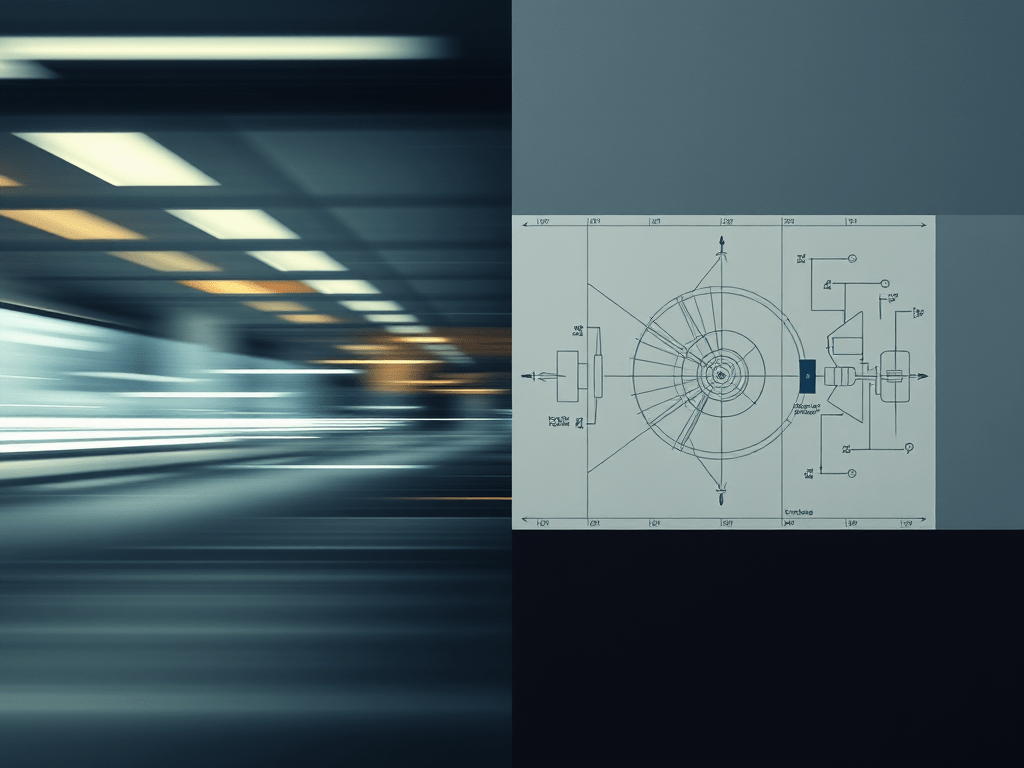
Movement and Mechanism: Why the Documentary and the Essay Must Exist Together
Human beings understand the world through two different modes: movement and structure. Movement is lived, felt, and experienced in time. Structure is recognized, named, and understood outside of time. Most forms of knowledge lean toward one or the other. Scientific reports remove movement to preserve structure. Diaries preserve movement but rarely identify structure. Narrative film tries to capture both, but only partially. The tension between these modes is unavoidable — and productive. What the documentary shows cannot be said in the essay, and what the essay reveals cannot be seen in the documentary. This project requires both because the subject of the project is precisely the relationship between movement and mechanism.
The documentary follows the movement of thought as it happens. It shows the search, the detours, the unexpected connections, the alignment of personal life with historical structure, and the role of technology as an active participant in meaning-formation. It preserves the instability of discovery — the fact that ideas rarely arrive fully formed and often contradict themselves before resolving. Film respects the temporal nature of insight. A realization does not appear as a conclusion but as an event. When something becomes clear in the documentary, it is because the viewer has seen the conditions that led to the recognition. Understanding is not announced; it is enacted.
The essay, by contrast, isolates mechanism. It removes the story’s motion in order to identify the structure beneath it. A concept in the documentary may appear through lived experience, but the essay must define the concept, place it within a system, describe its role, and establish its implications. If the documentary shows how ideas emerge, the essay shows how those ideas fit together. The documentary allows contradictions; the essay resolves them. The documentary uses time; the essay suspends time. One traces the arc of discovery; the other reveals the architecture.
Neither form is complete on its own. A documentary without the essay would remain an unfinished intuition — compelling, but lacking articulation. It would risk being interpreted as autobiography rather than structural research. An essay without the documentary would appear abstract, detached from experience, and ungrounded in lived reality. It would risk sounding like a theoretical claim rather than the result of years of observation. When combined, however, the two modes produce something neither could achieve individually: a single inquiry that reveals both the movement of meaning and the mechanism of meaning.
This dual method also mirrors the project’s larger argument. If human history follows a dramatic arc, and if individual lives reflect the same structure in a different scale, then any attempt to understand this pattern must use both experience and analysis. Movement corresponds to the personal arc; mechanism corresponds to the historical arc. The documentary captures the micro-level alignment — how the structure emerges within one life. The essay captures the macro-level logic — how the same structure governs civilizations. Together they demonstrate that meaning is neither purely subjective nor purely objective. It is relational: something that forms between experience and structure.
The purpose of writing the essays alongside the documentary is therefore not commentary, clarification, or expansion. It is symmetry. Each episode contains a movement that the essay freezes into a conceptual moment. Each essay contains a mechanism that the episode provides with lived context. Over time, the viewer and reader are shown both axes of meaning: the vertical axis (what the structure is) and the horizontal axis (how the structure moves). The result is a cumulative architecture in which the lived and the understood converge. That convergence is the center of the entire project.
This is why every season has a corresponding set of essays. Not because the documentary needs explanation, but because the structure needs a second mode. The two forms complete each other. Movement without mechanism is impression; mechanism without movement is abstraction. But movement clarified by mechanism — and mechanism grounded by movement — becomes understanding. And understanding is the material out of which meaning is built.
 laurentiuspaulus