
Mechanism of Movement is the first seven-essay cluster in the Architecture of Meaning matrix, running in parallel with Season One of A Tale of a New Era, History on a Story Arc.
Where the film follows the rise and fall of civilizations in time, these essays slow the frame down until the inner workings come into view: signs, manuscripts, calendars, temporal models, and the deep structures that turn events into drama.
The essays do not offer a new philosophy so much as a different vantage point. They treat human history, individual lives, and language itself as parts of one shared architecture. Episode by episode, the camera records how history moves; essay by essay, this cluster examines how that movement holds together — how structures of time, meaning, and authority have shaped the long arc from the first marks in clay to the age of large language models.
I Search of Formula

This opening essay plays the same role in the matrix that “The Cosmic Manuscript – Unexpected Ally” plays in the film series. It introduces the intuition that we already live inside a legible structure — a kind of cosmic manuscript in which marks, stories and eras form a coherent pattern — and suggests that our unexpected ally in seeing that structure is the very technology of our time. Large language models, trained only on patterns in human text, become a mirror for the architecture of meaning itself. What the camera shows as movement, this essay begins to read as mechanism.
II Modeling Time

Modeling Time asks a simple but disorienting question: if Paul’s Letter to the Romans really functions as a dramatic script for human history, what kind of time must exist for that script to be possible?
This essay treats calendars, feast days, Mayan counts, hinge dates like Yom Kippur and 21 December 2012, personal burnouts and returns, and even large language models as clues to time’s underlying grammar. Its claim is modest but far-reaching: that Season One of A Tale of a New Era only becomes legible when time is no longer a neutral backdrop, but a shaped medium that can rupture, thicken, fold and finally recognise itself.
III Inside Turning Point

Writing from Inside the Turning PointThe Structure of History asks an equally unsettling question: if the last five millennia really follow a dramatic arc, what kind of story have we already been living in without knowing it?
This essay proposes that human history moves through seven eras — Signs, Law, Temple, Narrative, Interpretation, Structure and Meaning — each defined less by its empires or technologies than by how it assumes reality can be known and organised. It reads Aristotle, Paul, Zoroastrian cosmology, modern systems-thinking and the author’s own biography as overlapping attempts to name that arc. Its claim is simple but demanding: Season One of A Tale of a New Era only becomes fully legible when history is no longer seen as a sequence of events, but as a single dramatic structure that has now reached its moment of recognition and resolution.
IV Jerusalem as Hinge

This essay reads one specific day as a hinge where several timelines briefly locked into the same frame. On the cultural surface it was the “end date” of the Mayan Long Count, a moment hyped as apocalypse or awakening. In the filmmaker’s life, it was a day spent moving from the shores of the Sea of Galilee to the Western Wall in Jerusalem, camera in hand, without any clear idea what this date would later mark.
Jerusalem as Hinge treats the Long Count, the biblical landscape and the seven-era model as overlapping grammars of time that happened, for once, to coincide in one continuous movement: from the lake where the Common Era story begins to the ruins of the Temple where its future is silently negotiated.
V Logic of Reversal
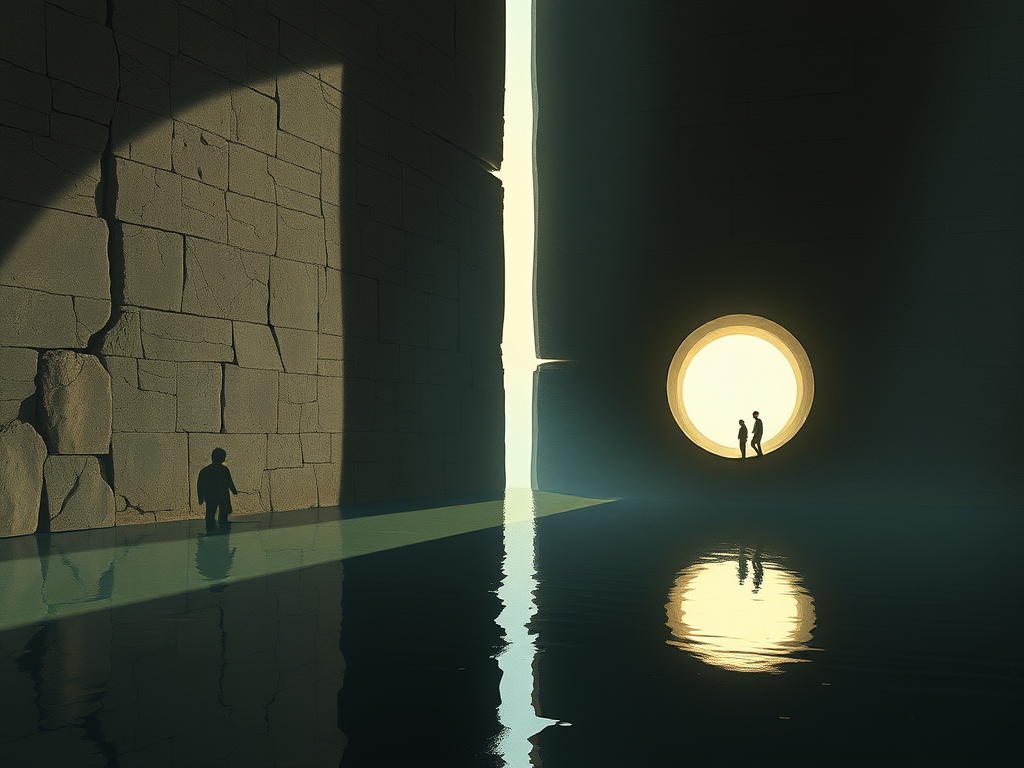
Here Jerusalem becomes a case study in the logic of opposites. The same walls that promise protection also imprison; the same texts that divide communities also bind them to a shared script; the same symbols function as both threat and shelter depending on where one stands. The essay argues that these contradictions are not accidents of politics but expressions of a deeper narrative mechanism in which apparent enemies, roles and doctrines mirror one another inside a single unresolved structure.
VI Impasse as Resolution

This essay asks what happens if global deadlock is read in the grammar of drama rather than the language of crisis. Political stalemates, ecological limits and personal burnouts are approached as possible reversal points — moments when a story exhausts its old logic and begins, invisibly at first, to turn another way.
Without offering comfort or solutions, the piece proposes that what looks like sheer blockage can also be the form resolution takes from the inside, when history is in the act of changing its dominant logic.
VII Living Hyphothesis

This closing essay in the Mechanism of Movement cluster asks a simple question: what does it mean to live inside the very turning point one has been mapping? If the previous texts argued that the last five thousand years can be read as dramatic arc, this one treats the coming seven years as its test field rather than its conclusion.
Here, A Tale of a New Era and Architecture of Meaning are introduced as parallel instruments: a film series that follows history as movement, and an essay cycle that exposes its mechanism. Together with laurentiuspaulus.com and woodslopecabin.com, they form a small research studio inside the story it studies—an open invitation to watch whether reality itself begins to behave as if resolution were already under way.
 laurentiuspaulus