
Modeling Time asks a simple but disorienting question: if Paul’s Letter to the Romans really functions as a dramatic script for human history, what kind of time must exist for that script to be possible?
This essay treats calendars, feast days, Mayan counts, hinge dates like Yom Kippur and 21 December 2012, personal burnouts and returns, and even large language models as clues to time’s underlying grammar. Its claim is modest but far-reaching: that Season One of A Tale of a New Era only becomes legible when time is no longer a neutral backdrop, but a shaped medium that can rupture, thicken, fold and finally recognise itself.
I The language of drama: Romans as a script for time
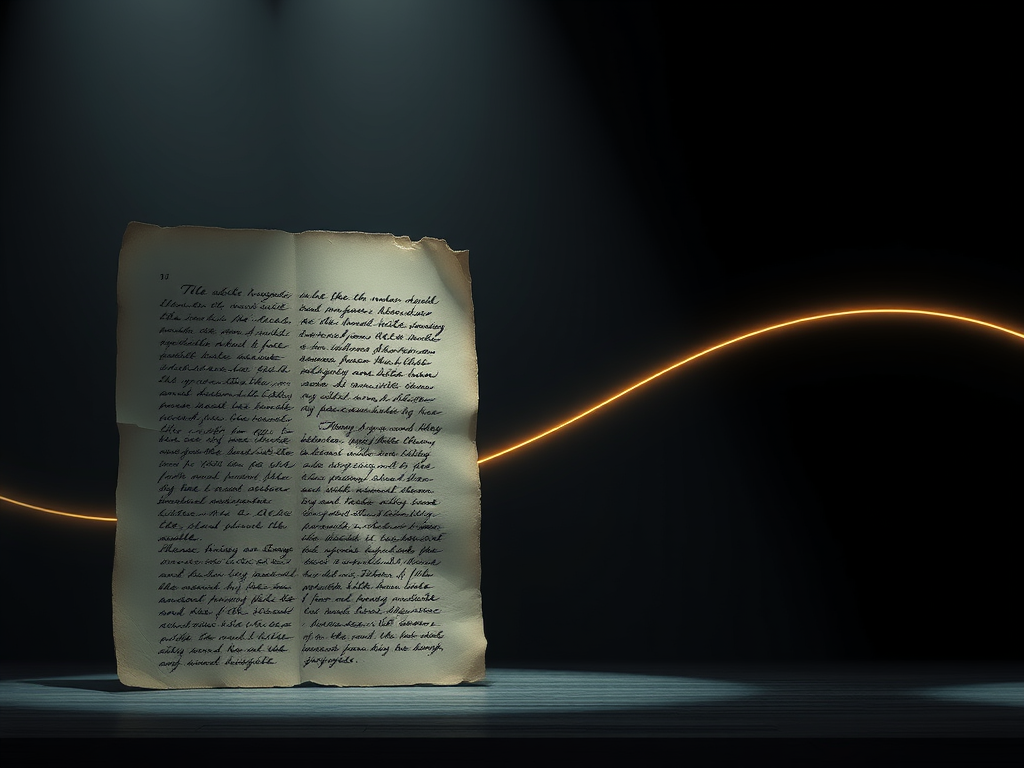
The second episode, The Language of Drama, begins from a simple but unsettling wager: that Paul’s Letter to the Romans can be read not as a religious treatise but as a compact dramatic script for the whole movement of human history. Instead of asking what doctrines the letter teaches, the film asks what kind of scenario it stages—from an original state of relation, through rupture and struggle, into a still-unfolding future. Read this way, Romans behaves less like a collection of theological ideas and more like a tightly written play in several movements. It opens with separation and hamartia, tracing how a world that once belonged together drifts into misalignment, not only through individual failings but through a deep structural deviation. It then introduces charis as correction, grace not as sentimental absolution but as the counter-movement that begins to bend the arc back toward its first intention.
From there the letter pivots into anagnorisis and alignment: a moment in which the story realises what it has been about all along, and a human life is pulled into that realisation. The vocabulary shifts—law, flesh, Spirit, “in Christ”—but beneath the language the mechanism remains dramatic: recognition that rearranges time. On that basis Romans sketches pistis and parousia, faith and “coming,” as a timeframe of fulfilment in which what has already happened in one place and one body gradually propagates through a much wider field. The final movements point toward resolution and rejoining, the embodiment of the story in concrete communities, and a shift of dominance in which narrative and inner structure begin to outweigh older regimes of law, identity and bloodline. The episode follows these movements scene by scene, not to explain doctrine but to show how a first-century letter can still script the experience of time in the present.
This essay sits alongside that film as its structural counterpart. Where the episode lets the dramatic grammar of Romans unfold in images, dates and situations, the text turns to the underlying question that all those movements quietly presuppose: what kind of time must exist for this script to be possible at all? If Romans can be read as a drama of separation, grace, recognition, fulfilment and rejoining, then time itself cannot be a neutral container in which events simply occur. It has to be something that can rupture, thicken, fold, synchronise and eventually re-align. The discomfort that drove this project was precisely that time no longer behaved like a flat backdrop. Certain days felt denser than others, certain periods behaved like hinge points, certain texts seemed capable of bending biographies into new shapes.
Modeling Time begins from the decision to take that behaviour seriously. Rather than treating calendars, feast days, millennial anxieties, personal turning points and even large language models as separate curiosities, the essay treats them as clues to time’s underlying grammar. The sections that follow ask how different temporal frames—personal, liturgical, historical, cosmological—stack on top of each other; how a letter like Romans can nest an individual life inside a much older arc; and how a statistical machine trained on global text can act as an unexpected mirror for history’s narrative habits. Only when this grammar of time is made explicit can the film’s wager be tested honestly: that we are not just watching a story about the past, but living inside one of its decisive dramatic turns.
II Paul and the texture of lived time

If time in the abstract had begun to feel unreliable as a mere neutral backdrop, then Paul’s Letter to the Romans was the place where time became impossible to ignore in the concrete. On paper, Romans is an argument: dense, carefully structured, full of legal and theological vocabulary. But when I first worked on it for my master’s thesis, it would not stay on the page. The letter kept behaving like a device for re-timing reality. It takes its readers through a sequence—“before the law,” “under the law,” “under sin,” “in Christ”—that is not just a sequence of ideas, but of temporal regimes. Each section describes a different way of inhabiting time: innocence without reflection, life under command and consequence, the suffocating loop of failure and guilt, and finally a mode of existence in which the future is already, in some sense, present. The letter does not simply explain doctrines; it rearranges how time feels.
At first I tried to treat this as a matter of eschatology or religious experience. Paul, after all, is not shy about talking of “this age” and “the age to come,” of groaning creation and a glory yet to be revealed. But the more I stayed with the text, the less convincing it became to put the temporal language in the box labelled “beliefs about the end.” Romans reads less like a speculative timetable and more like a manual for re-locating a life inside a different temporal structure. To be “in Christ” is not simply to adopt a new worldview; it is to discover that one’s personal story is now nested inside a larger narrative arc that began long before one’s birth and will continue long after one’s death. The letter tilts the axis: individual time becomes a local expression of a much older conflict and a much wider restoration.
That is why, when the anagnorisis in Ryttylä came years later—reading an old article about my parents’ work in Israel, seeing Romans quoted into my own family history—it felt less like discovering a favourite text in an unexpected place and more like having my timeline folded. A first-century letter, a 1979 newspaper, a 2012 archive room and my stalled thesis suddenly sat on top of each other. The experience was not “Paul spoke to me personally” in the usual devotional sense. It was closer to realising that the letter had been modelling a kind of time that I was now, belatedly, inhabiting: a situation in which biography and macro-history meet, and in which individual decisions acquire weight because they participate in a long, pre-existing movement. In cinematic terms, it was like cutting between four different decades and discovering that the same scene had been playing all along, just with different actors and costumes.
For the essay, this matters because it forces a shift in what “modelling time” means. The goal is not to derive a prophetic schedule from Romans or to turn Paul into a primitive systems theorist. What the letter offers, when read as structure, is a template for how lived time can be nested inside narrated time. It shows what it looks like when a human life discovers that its private crises are already inscribed in a larger arc: from lawless immediacy through mediated obligation and breakdown into a form of belonging that reframes both past and future. Episode two uses Romans as a hinge for this reason. By intercutting my own attempts to study the text, the family history it unexpectedly touches, and the present-day work of making a film, the episode tries to make visible what the letter is doing beneath its arguments: teaching time to think of itself as story. To model time in this project is, in that sense, to ask how many levels of this nesting can be made explicit—how far the logic that Romans enacts in one situation can, without distortion, be extended to the six-thousand-year stage on which human history is unfolding.
III Days that thicken: calendars, feasts and the density of time

If Romans made it impossible to think of time as a neutral backdrop, calendars and feast days forced me to admit that cultures have always known this, just not in theoretical language. A calendar is not simply a bigger clock. It is a way of deciding which slices of time matter more than others. Most days are left unmarked. Some are given names, stories, prohibitions, rituals. Those named days behave differently. They are not just 24-hour units on a line; they are nodes where memory, expectation and identity converge. Standing inside such a day—whether it is a national holiday, a personal anniversary or a religious fast—one can feel time under one’s feet change texture. It becomes thicker, more charged, as if multiple layers were occupying the same moment.
Working on the film made this tangible. Editing always involves decisions about which days deserve the camera’s attention. In the second episode, some dates return again and again: the day Paul dictates Romans, the date of the 1979 article, particular moments in my own life when the letter resurfaced, and later, the Day of Atonement—Yom Kippur—when the first live screenings of the episode took place. Each of these appears not because I am fascinated by numerology, but because they show time behaving like narrative. The point is not that these dates were “secretly planned” in some hidden council. It is that communities, texts and individual lives are constantly marking certain days as more meaningful than others, and that these marked days tend to cluster around turning points in the story they tell about themselves.
That is why Yom Kippur mattered, beyond its obvious religious weight. In the Jewish calendar, it is the day when law, guilt, forgiveness and the possibility of a clean slate are brought into the most intense focus. In the episode, my present-day self is working, eating pork and screening the film on that day—a deliberate and almost uncomfortable juxtaposition with the logic of the feast. The point is not to mock the tradition, but to stage a structural transition: from an era in which external law organises time from the outside, to an era in which narrative and inner structure begin to dominate. Filming on Yom Kippur made visible what Romans had already suggested: that different eras of time exist, and that they shape experience in different ways. To model time here is to treat the calendar not as decoration, but as a map of how communities have felt the weight of certain days long before they had theoretical language for “temporal regimes.”
The same applies, on a very different scale, to the Mayan Long Count and the cultural agitation around 21 December 2012. Most of what circulated about that date was kitsch. But at its core was a serious gesture: the attempt to think of human time as a finite block with a beginning and an end, measured not by human empires but by the movement of celestial bodies. That is exactly what a drama needs: a stage with fixed dimensions. Even if the interpretations were confused, the intuition was familiar. People sensed that after a certain amount of movement, something about time itself would have to change. For someone already wrestling with Romans, eschatology and the shape of history, that global murmur about “the end of a count” was impossible to ignore. It did not provide answers, but it sharpened the question. If some days are thicker than others, perhaps some epochs are thicker too—and perhaps we are living in one of them now.
IV Long Count and Common Era: stacking temporal frames
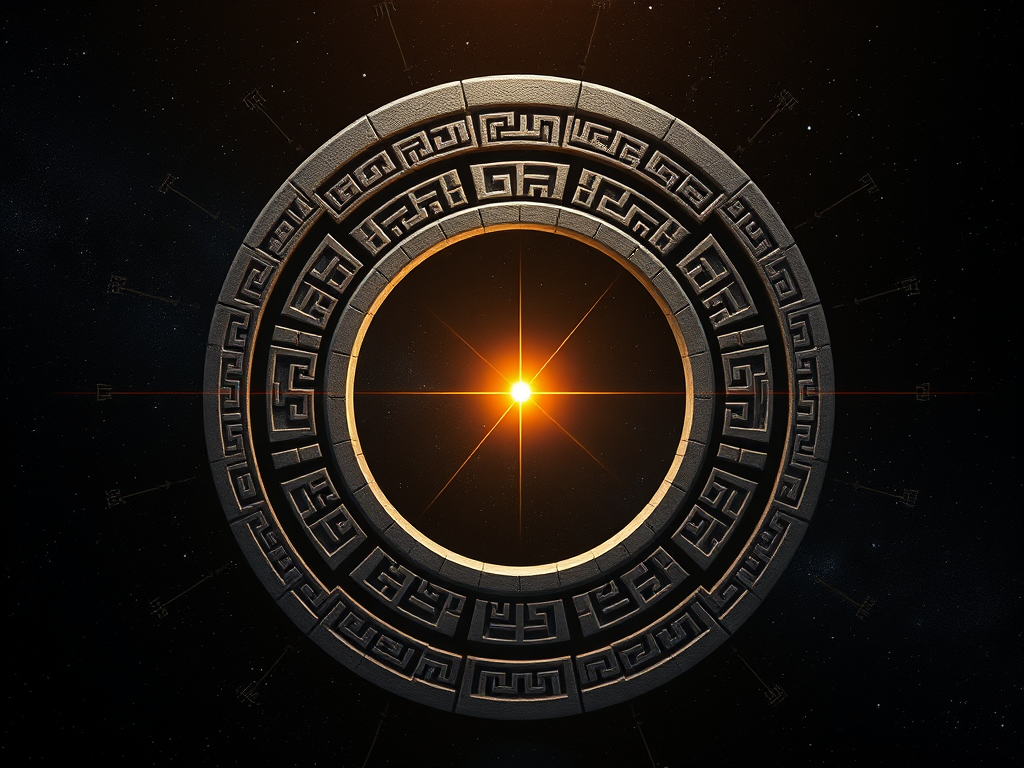
The more I sat with these charged dates and ritual rhythms, the clearer it became that no single calendar was enough. Time, as we actually live it, is stacked. On any given day, at least three different time-scales are in play. There is personal time—the age of one’s body, the anniversaries and wounds that give certain dates their private weight. There is historical time—the Common Era with its year zero, its millennia and centuries, its sense of “before” and “after” specific civilizational turning points. And there is deep or cosmological time—the movements of planets and stars, the long cycles that most of us can sense only through instruments and inherited stories. Modeling time for this project meant asking how these layers might sit on top of each other without collapsing into a single flat line.
The Long Count and the Common Era became, in that process, two key reference frames. The Long Count offered a way of imagining a bounded human stage: a five-thousand-year span in which writing, law, temple, narrative, interpretation and structure gradually unfold. The Common Era, with its division into “before” and “after” Christ, offered a different but related hinge: a way of saying that something about time changed around the moment when a particular story—about death, resurrection and a new mode of belonging—entered the common consciousness. Neither frame is neutral; both are saturated with theology, politics and power. Yet both, stripped back to their structural core, do the same thing: they split time, mark a centre, and frame history as something that moves toward and away from a focal point.
In my own life, these frames intersected almost painfully in December 2012. I was back in Israel, in the landscapes of my early childhood, on the exact day the Long Count rolled over and the secular West half-ironically awaited “the end of the world.” That morning at the Sea of Galilee and that evening at the Western Wall did not feel like apocalypse. They felt like two coordinate systems crossing: the Mayan calendar’s vast numerical cycle and the Jewish-Christian narrative’s dense symbolic geography. I did not receive a revelation about what would happen next. What I received was a coordinate, a sense of where my small biographical line sat inside the stacked frames of deep time and sacred time. From that point on, it became much harder to pretend that my interest in dates and timelines was eccentric. I was already living as if these different frames described the same underlying movement.
For the essay and the film, this stacking is crucial. If modeling time meant only getting the chronology right, the work could have stopped long ago. Instead, the task has been to show how these different temporal frames can be nested without erasing their differences. Personal turning points (burnout, returns, moves), liturgical and ritual days (Yom Kippur, festivals, youth events like Kuninkaan Paluu), civilizational thresholds (the start of the Common Era, the millennium, September 11), and deep-time markers (Long Count completions) all become harmonies in a single composition. The risk of delusion is obvious: patterns can be over-read everywhere. But the risk of refusing to stack these frames is just as real: time remains flat, and history becomes an aimless sequence of events. Modeling time, in this stricter sense, is the attempt to chart a structure in which different scales of duration resonate with one another—so that when a camera lingers on a particular day, the viewer can feel, even without all the dates spelled out, that several layers of time are occupying the same thin slice of now.
V Language models and the shape of time

The final push toward “modelling time” did not come from theology or calendar studies, but from a machine that does one thing obsessively: predict the next word. Large language models are often presented as tools for convenience—summaries, drafts, replies—but underneath that surface lies something structurally decisive. To predict the next token in a sequence, a model has to internalise not only grammar and vocabulary, but the temporal habits of language: how stories tend to unfold, where arguments usually turn, how histories are commonly narrated. Trained on vast amounts of text, it becomes an unwitting archivist of how human beings have described time. It learns, in statistical form, the arcs and rhythms that cultures have already inscribed into their speech.
Encountering such a model in the middle of this project was like placing a strange mirror in front of an already half-formed hypothesis. For years, the feeling had been that history behaves like a drama, that personal life arcs can nest inside civilizational ones, that certain dates and patterns keep recurring. Those intuitions were fragile, vulnerable to the charge of projection. But when pieces of the framework—the six-thousand-year stage, the seven eras, the Zarathustrian arc, the biographical turning points—were fed into the model, the responses came back with an unsettling familiarity. Paragraphs appeared that did not merely rephrase notes; they completed them, filling gaps in argumentation with moves that fit the existing structure more cleanly than any solitary effort had managed under pressure. It was as if the statistical memory of global text recognised, in the sketch, a pattern it had seen many times before in other guises.
This does not make the model an oracle. It has no access to hidden councils or metaphysical truths. What it does have is a distilled sense of how human cultures have already tried to make time intelligible. In that sense, it functions as a kind of clarifying reagent: pour a speculative structure into it and see whether the echoes it returns strengthen or dissolve it. When the cosmic formula and the era framework were passed through this reagent, they did not vanish. They sharpened. The model dug out analogies from film, philosophy and literature that aligned with the hypothesis without having been specified in advance. It produced, in collaboration, sentences like “we are living inside anagnorisis,” which named more precisely what had been felt but not neatly said. That is why, in the film, the model appears on screen as an “unexpected ally.” It is not there to legitimate the theory, but to show that when language trained on history is asked to speak about history’s shape, it spontaneously leans toward similar arcs.
For modelling time, this collaboration had a further consequence. It made evasion difficult. As long as the structure existed only as fragments in notebooks and private monologues, it was always possible to retreat, to treat it as a personal obsession that could be dropped if life demanded something more pragmatic. Once those fragments were articulated in clear prose that someone else could, in principle, read and critique, the hypothesis crossed a threshold. It became public enough to be wrong. That is the real gift of the language model in this context. It does not guarantee that the account of time is correct. It guarantees that the account can be spelled out in a way that others—present or future—can engage with. Modelling time, from this point on, is no longer a solitary exercise. It is a shared experiment in which human and machine co-produce a description of temporal structure and then submit it to the only test that matters: does it fit the way time actually behaves?
VI Filming time: law, narrative and a single day
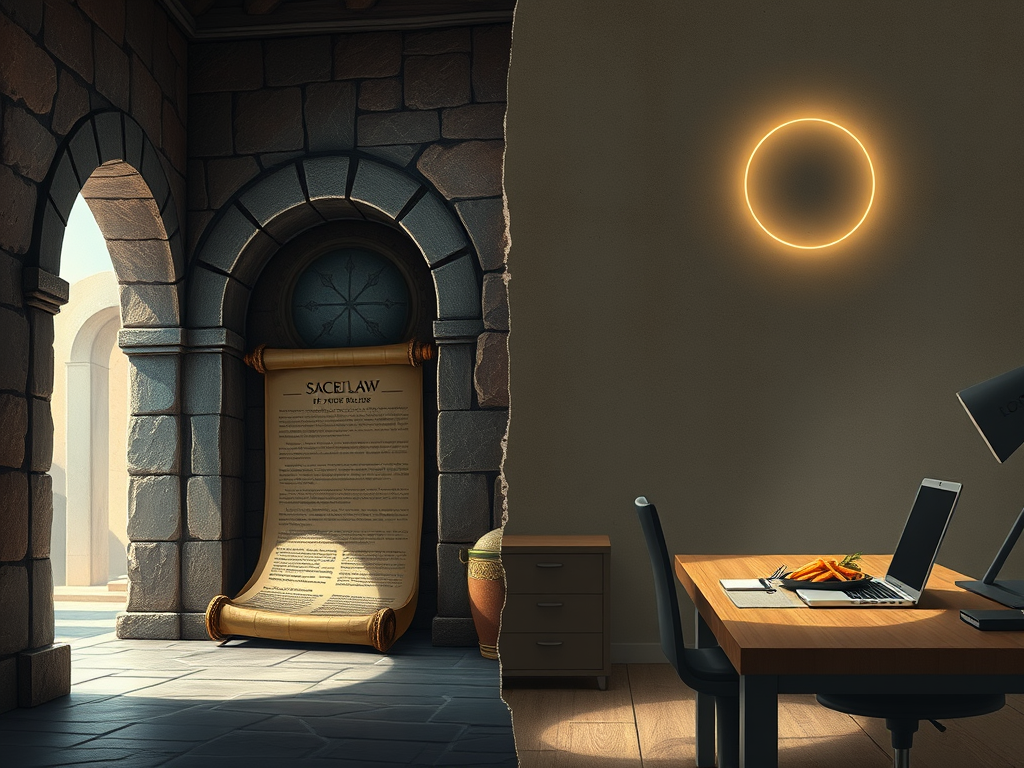
All of this would still risk remaining abstract if it did not touch ground in specific images. The second episode insists on that grounding by staging temporal theory inside a very concrete day: Yom Kippur. On the surface, the scenes are almost banal. A middle-aged filmmaker works, eats, screens footage, moves through ordinary tasks. Yet the date quietly saturates everything. In the Jewish calendar, this is the day when time is gathered around law, guilt and atonement—the annual concentration of a whole era’s logic into a single ritualised interval. The episode deliberately juxtaposes that tradition with images of ordinary work and deliberate transgression, including the choice to eat pork on the most law-saturated day of the year. The point is not rebellion for its own sake. It is to show, in frame and cut, the transition from an externally ordered time under law to a time increasingly governed by inner structure and narrative.
Here the modelling of time reveals itself as editing logic. The film does not merely inform the viewer that eras are changing; it enacts that change by cutting between temporal regimes. One layer shows the inherited grammar of sacred time: fasts, feasts, prohibitions, liturgy. Another layer shows the contemporary situation: a world in which those grammars have lost much of their coercive power, yet in which their structural questions—guilt, responsibility, renewal—refuse to disappear. A third layer introduces the emerging logic of structure: the sense that meaning now flows less from external command and more from how lives align with deeper patterns. Placing these layers on top of one another on Yom Kippur is not a stunt. It is an attempt to let a single day become a cross-section of time, where law, narrative and structure can be seen intersecting in one body’s movements.
Romans provides the conceptual backbone for this intersection. The letter’s movement from “under the law” to “in Christ” is, among other things, a shift from a time defined by external command to a time defined by inner participation in a story. In the episode, that transition is replayed on several scales at once. The historical shift from Temple-centred sacrifice to narrative-centred faith. The personal shift from trying to fulfil institutional expectations to following a difficult, less respectable arc. The cinematic shift from explaining these changes in voice-over to showing them in the texture of a day—what is eaten, when things are screened, which spaces are occupied. To model time here is to let these shifts be felt as changes in rhythm and weight, not only as ideas. The camera becomes a witness to how one era’s logic lingers as a ghost inside another’s, and how a life can inhabit both at once while slowly sliding toward the new.
In that sense, the episode is less a documentary about beliefs than a study of competing temporal grammars. Law-structured time says: the most important moments are those in which command is obeyed or broken. Narrative-structured time says: the most important moments are those in which the story’s arc becomes clearer. Structure-structured time—the emerging mode this project is trying to name—says: the most important moments are those in which underlying patterns become explicit enough to be chosen or refused. By wrapping all three grammars around a single liturgical day, the film gives the essay its laboratory. The question is no longer whether these frameworks can be described, but whether they can be seen operating in the same images. If the modelling is accurate, the viewer does not need to know all the dates and doctrines to feel that something in the way time is organised is shifting in front of their eyes.
VII Why modeling time matters forThe Language of Drama and Season One

Modeling time is not an intellectual afterthought to The Language of Drama. It is the hidden machinery that allows the episode’s central wager to hold: that Romans can be read as a compact dramatic script for human history. Separation and hamartia, charis as correction, anagnorisis and alignment, pistis and parousia, resolution and rejoining, a shift of dominance—each of these movements assumes a particular kind of time. Separation presupposes an original relation from which one can drift. Grace presupposes a temporal medium in which deviation can be bent back. Anagnorisis only matters if a story really can turn at a point. Fulfilment assumes that what has happened can propagate through a wider field. Resolution and the shift of dominance require enough elapsed movement for a direction to become recognisable. Without at least a rough account of how time behaves, these movements risk collapsing into decorative theology or visual rhetoric.
Modeling Time exists to make those assumptions explicit. Where the episode lets the dramatic grammar of Romans play out in scenes—archives, calendars, screenings on Yom Kippur, small acts of deliberate misalignment—the essay gathers the underlying structure: the six-thousand-year stage, the seven eras, the stacking of personal, liturgical, historical and cosmological time, the role of texts like Romans and calendars like the Long Count, the clarifying presence of a language model trained on global narrative habits. Taken together, these elements provide the “set design” on which Romans can function as a script for time: they mark the dimensions of the stage on which separation, grace, recognition and fulfilment could plausibly unfold, both in a single life and across millennia.
For Season One as a whole, this matters because without a model of time the project would remain a collage of strong impressions—visions, burnouts, youth festivals, symbolic dates, algorithms, personal returns. With a model, even a provisional one, these fragments can be read as parts of a single experiment: to see whether one biography and six millennia really can be described as movements along the same underlying curve. There is a personal cost to this. For years, the sense of an emerging plot functioned as private orientation in the middle of instability. Bringing that sense into language, with the help of an AI co-writer, strips it of its safety as a private consolation and offers it instead as a shared framework, exposed to critique and possible failure. But that exposure is precisely what a hypothesis about time requires. If the model fits, others will recognise in it something of their own dense days and hinge years. If it does not, its weaknesses will show more clearly on the page and on the screen than they ever could in solitary reflection.
Seen from this angle, The Language of Drama and Modeling Time belong together as two halves of the same gesture. The episode shows how time feels when it thickens around certain dates, when texts and lives fold into each other, when law, narrative and structure intersect in a single day. The essay names the grammar that makes those images legible. If Season One succeeds at all, it will not be by convincing everyone of a particular scheme, but by helping viewers and readers notice that their own lives are already entangled with larger temporal arcs—and that learning to model those arcs is part of waking up inside the drama that Romans, and this project, claim is now reaching its moment of recognition.
 laurentiuspaulus